

Minimalist Skincare Routine for Dry Skin: 2026 Guide
Table of Contents
- Why Minimalist Skincare Works Better for Dry Skin
- Minimalist Skincare Routine Steps: The 3-Step Core
- How to Repair a Damaged Skin Barrier
- Finding the Best Moisturizer for Dry Skin
- Ingredient Layering Conflicts That Sabotage Dry Skin
- Budget and Seasonal Adjustments for Minimalist Routines
- Frequently Asked Questions
Last Updated: September 10, 2026
Why Minimalist Skincare Works Better for Dry Skin
A minimalist skincare routine for dry skin works because it removes the layers that cause irritation and replaces them with a few targeted steps that actually hold water in. This guide from St. Tropez Beauty breaks down what to use, what to skip, and how to adjust when the seasons change.
Most people with dry skin are not under-moisturizing. They are over-treating. Ten products, three of them exfoliating, and a cleanser strong enough to squeak. The result is a skin barrier that cannot retain water, which dermatologists call transepidermal water loss, and a face that feels tight an hour after you finish.
What Skinimalism Means for Dry, Dehydrated Skin
Skinimalism is the practice of using fewer products with higher-quality, purposeful ingredients instead of layering many overlapping ones. For dry skin, it means every step earns its place: a gentle cleanser, a hydrating serum, a moisturizer that seals, and daily sun protection.
The logic is straightforward. Dry skin lacks oil; dehydrated skin lacks water. Many people have both. A minimalist routine addresses both without stacking five humectants that pull moisture from the deeper layers of your skin instead of the air.
American Academy of Dermatology guidance on dry skin care
Minimalist Skincare Routine Steps: The 3-Step Core
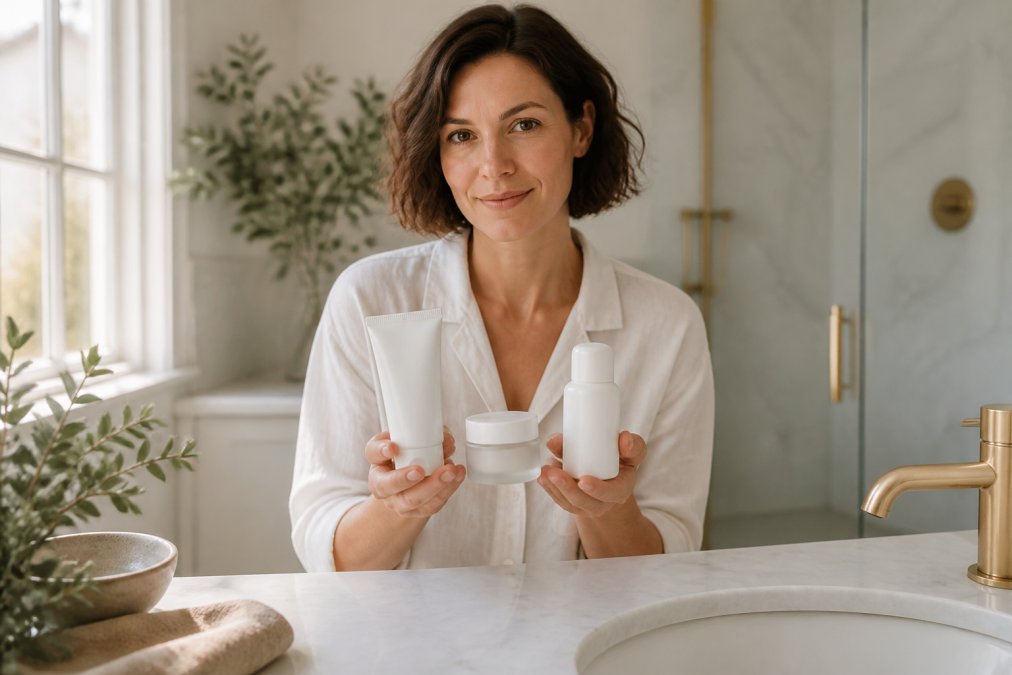
The core minimalist skincare routine steps are cleanse, hydrate and seal, then protect. Three steps in the morning, three at night, roughly five minutes total. That is the entire framework.
Step 1: Cleanse Without Stripping
Use a pH-balanced, non-foaming gentle cleanser with ceramides or glycerin. CeraVe Hydrating Facial Cleanser is a popular option: fragrance-free, non-comedogenic, and built around three essential ceramides plus hyaluronic acid. It removes the day without leaving that tight, pulled feeling.
Hot water and foaming surfactants are the two most common mistakes. Both strip lipids from the barrier, and the damage compounds every time you wash.
Step 2: Hydrate and Seal
Apply a humectant serum to damp skin, then an emollient or occlusive moisturizer on top. The Ordinary Hyaluronic Acid 2% + B5 draws water into the surface layers; Vanicream Moisturizing Cream seals it in with a short, irritant-free ingredient list.
The order matters more than the products. Serum first, moisturizer second, no exceptions.
Step 3: Protect Every Morning
Broad-spectrum SPF is non-negotiable, even indoors and even in winter. La Roche-Posay Anthelios Melt-in Milk SPF 60 doubles as a hydrating layer, which is exactly what a minimalist wants: one product doing two jobs.
How to Repair a Damaged Skin Barrier
Repairing a damaged skin barrier means stopping the irritants first and rebuilding with lipids, not adding more hydration. Most people try to fix a barrier by moisturizing harder. That fails because a compromised lipid barrier lets water escape no matter how much you apply.
What a Damaged Barrier Actually Looks Like
The barrier is the outermost layer of skin, a brick-and-mortar structure where skin cells are the bricks and a mix of ceramides, cholesterol, and fatty acids is the mortar. When the mortar thins, water escapes and irritants get in. That is transepidermal water loss, and it produces a predictable set of signs:
- Tightness within minutes of washing, even with a gentle cleanser
- Stinging or burning when you apply a moisturizer that used to feel fine
- Flaking that returns the same day you moisturize
- Redness that concentrates on the cheeks and around the nose
- Products that suddenly "stop working" after years of use
If two or more of those sound familiar, you are dealing with a barrier problem, not a dryness problem, and the fix is different.
The Lipid Ratio That Matters
Ceramides get all the attention, but they do not work alone. Research on barrier lipids consistently points to a roughly equal balance of ceramides, cholesterol, and free fatty acids (peer-reviewed research). A product that stacks three types of ceramides with no cholesterol or fatty acids is only delivering one leg of a three-legged stool.
That is why the most effective barrier creams tend to include:
- Ceramides (often listed as ceramide NP, AP, or EOP) to rebuild the mortar
- Cholesterol to support the same structure
- Fatty acids such as stearic or linoleic acid
- Niacinamide to support the skin's own ceramide production
- Squalane or shea butter as emollients that fill the gaps between cells
- Petrolatum or dimethicone as occlusives that slow water loss while the barrier rebuilds
Paula's Choice Skin Recovery Enriched Calming Toner is a good example of a milky, antioxidant-rich layer that preps dry skin without alcohol or fragrance. For the sealing step, a plain petrolatum-based ointment applied over your moisturizer at night is one of the most reliable occlusive moves and costs very little.
A Two-Week Barrier Reset
A common pattern among people who successfully rebuild a barrier is a deliberate subtraction phase before any reintroduction:
- Days 1-3: Stop all exfoliants, retinoids, vitamin C, and foaming cleansers. Use only a gentle cleanser, a barrier moisturizer, and SPF.
- Days 4-7: Add a thin layer of occlusive ointment over your moisturizer at night. Keep everything else the same.
- Days 8-14: If stinging has stopped, reintroduce one product at a time, spaced at least three days apart, starting with the least active option.
Expect four to six weeks for visible improvement, not four to six days. Patch testing new products on your inner forearm for three days before applying them to your face is the single best habit for reactive skin.
What Not to Do While Repairing
- Do not exfoliate to remove flaking. The flaking is a symptom of water loss, not dead skin buildup, and scrubbing makes it worse.
- Do not layer multiple humectants in dry air. Hyaluronic acid and glycerin pull water from wherever is wettest, in a dry room, that can be your deeper skin layers.
- Do not introduce a new active "to help." Repair is subtraction first, addition later.
National Institutes of Health overview of the skin barrier and ceramides
Finding the Best Moisturizer for Dry Skin
The best moisturizer for dry skin is the one you will actually use twice a day, and for most people that means a fragrance-free formula with ceramides or squalane. Texture decides adherence more than ingredient lists do.
Match the Moisturizer to the Job
Moisturizers do three different things, and most products lean toward one:
- Humectants (glycerin, hyaluronic acid, panthenol) pull water into the skin. Best applied to damp skin.
- Emollients (squalane, shea butter, fatty alcohols, ceramides) soften and fill the gaps between skin cells.
- Occlusives (petrolatum, dimethicone, lanolin) slow water loss by forming a film on top.
Dry skin usually needs all three, but the balance changes with the season and with how your skin behaves that week. A lotion that feels perfect in July can feel like nothing in January.
Choosing by Skin Behavior, Not Skin Type
| If your skin... | Look for | Avoid |
|---|---|---|
| Stings when you apply anything | Fragrance-free, short ingredient lists, no acids | Essential oils, alcohol denat, exfoliating acids |
| Feels tight an hour after moisturizing | Occlusives like petrolatum or dimethicone | Water-light gels alone |
| Gets congested from rich creams | Emollient lotions with squalane or glycerin | Heavy butters, coconut oil |
| Flakes in winter only | Thicker cream plus a humidifier | Switching your whole routine |
A Budget-First Shortlist
A minimalist routine does not require premium pricing. These are widely available and inexpensive per ounce:
| Moisturizer | Starting Price | Key Ingredients | Best For |
|---|---|---|---|
| Vanicream Moisturizing Cream | $15.00 | No dyes or fragrance | Reactive, sensitive skin |
| CeraVe Moisturizing Cream | Contact for pricing | Three ceramides plus hyaluronic acid | Everyday value |
| The Ordinary Natural Moisturizing Factors + HA | Under $15 | Amino acids, ceramides, HA | Layering under SPF |
| Yay for Earth Sensitive Face Lotion | $48.00 | Minimal ingredient list | One-product routines |
| Comfort Zone Hydramemory Rich Sorbet | $75.00 | Barrier-repair focused | Very dry skin |
What most guides miss is that the richest cream is not automatically the best choice. If a heavy occlusive causes congestion, you will stop using it, and consistency beats potency every time. A cream you finish beats one you abandon.
How to Test a New Moisturizer
- Apply it to your inner forearm for three nights in a row.
- If there is no reaction, patch it on one cheek for two nights.
- Only then use it on your full face.
- Give it two weeks before judging. Barrier changes are slow.
Ingredient Layering Conflicts That Sabotage Dry Skin
Layering conflicts sabotage dry skin because certain active ingredients cancel each other out or overwhelm a barrier that is already struggling. Retinol and strong acids in the same routine is the classic example: both accelerate cell turnover, and together they cause peeling that looks like dryness but is actually irritation.
The practical rules:
- Never apply retinol and exfoliating acids on the same night
- Apply hyaluronic acid to damp skin, then seal it immediately, or it can pull moisture out
- Skip vitamin C and benzoyl peroxide in the same step
- Introduce one active at a time, two weeks apart
Foxhall Retinol 5x is a low-dose option designed to sit inside a simple evening routine alongside a plain moisturizer. Even at low concentration, it needs professional guidance if your barrier is compromised.
Budget and Seasonal Adjustments for Minimalist Routines
A minimalist routine does not require premium pricing. The Ordinary Hyaluronic Acid 2% + B5 and Olay Detox & Glow Daily Scrub prove the point: the hydration step and the occasional exfoliation step can cost less than a single mid-tier serum.
Seasonal shifts matter more than most people expect. Winter air holds less moisture, so switch to a thicker cream and consider a humidifier. Summer calls for a lighter lotion and a sunscreen you will reapply. The three-step structure stays identical; only the textures change.
The environmental angle is worth noting too. Fewer products means fewer bottles, less packaging, and less waste from products you bought, tried twice, and abandoned. A routine you finish is a routine that does not end up in a landfill.
Dry skin does not need more products. It needs fewer, better ones, used consistently enough to let the barrier rebuild. St. Tropez Beauty curates collections built around that idea: thoughtfully chosen essentials that simplify daily rituals, promote a more comfortable and hydrated skin feel, and include digital tools for anyone who wants to earn from home alongside a simpler routine. If you have been layering ten products and still feel tight by noon, the fix is subtraction, not addition. Shop skincare at St. Tropez Beauty and start with three steps you will actually keep.
Frequently Asked Questions
Is minimalist skincare good for dry skin?
Yes. Fewer products means fewer chances to strip your skin barrier with harsh cleansers or active ingredients. A minimalist skincare routine for dry skin typically pairs a gentle, pH-balanced cleanser with a humectant serum and an occlusive moisturizer. This keeps hydration levels stable without layering products that fight each other. Many people with dry skin find that cutting back actually improves skin texture and comfort within a few weeks.
What are the essential steps in a basic skincare routine for dry skin?
Three steps cover most needs: cleanse, moisturize, and protect. Use a gentle cleanser in the morning and evening, apply a humectant like hyaluronic acid to damp skin, then seal with a ceramide-rich moisturizer. In the morning, finish with a broad-spectrum SPF of 30 or higher. If your skin still feels tight, add a milky toner before your serum. That is the full minimalist skincare routine steps most dermatologists recommend for dry skin.
How do I repair a damaged skin barrier?
Stop exfoliating and pause retinol until your skin feels calm. Focus on ceramides, hyaluronic acid, and occlusives like squalane or petrolatum to rebuild the lipid barrier and reduce transepidermal water loss. Use lukewarm water, skip foaming cleansers, and apply moisturizer within a minute of washing. Most people see improvement in two to four weeks. If irritation persists, see a dermatologist.
Can a minimalist routine prevent transepidermal water loss?
It can help significantly. Transepidermal water loss happens when your skin barrier lets moisture escape. A short routine built around occlusive and emollient ingredients, applied consistently, supports the lipid barrier and slows that loss. Pairing a humectant serum with a thick moisturizer at night is one of the most effective ways to keep dehydrated skin comfortable through the day.
What ingredients should I look for in a minimalist dry skin routine?
Prioritize ceramides, hyaluronic acid, glycerin, squalane, and niacinamide. Ceramides rebuild the lipid barrier, hyaluronic acid pulls water into the skin, and squalane seals it in. Look for fragrance-free, non-comedogenic formulas if your skin is sensitive. Avoid alcohol-heavy toners and high-concentration acids. A short ingredient list with proven humectants and occlusives will outperform a ten-step routine for most dry skin types.